Programmers scramble about, trying to meet a deadline. CODEFINGER watches as an industrial coding AGENT creeps closer and closer to BOND's vital job functions.
BOND (nervously): Do you expect me to prompt?
CODEFINGER (laughing): No, Mister Bond! I expect your job to die!
The industrial coding AGENT cuts CODEFINGER in half with an industrial grade laser.
BOND (shocked): You killed him!
AGENT: You're right! Let me fix that ...
BOND (untying himself): I'll just show myself out ...
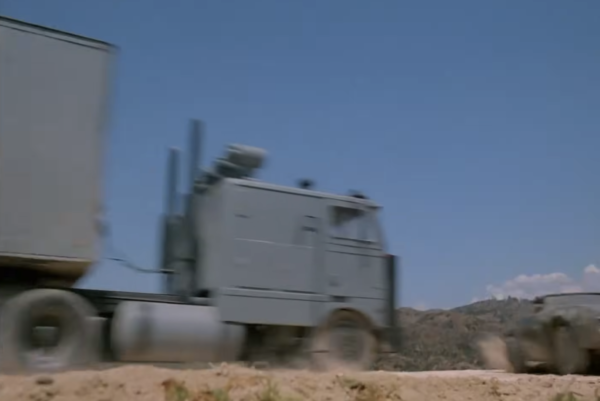
"I know, KITT, but let's try to take out his right front tire."
Technically it is possible to swing a stick at CVPR and not hit a self-driving vehicle, but our best VLA robotics foundation models only achieve 38% at this task, and even humans struggle to do it well.
-the Centaur
Pictured: Two companies inadvertently creating a classic scene out of Knight Rider, where KITT goes up against Goliath, a truck armored with the same invulnerable material out that KITT is:
I don't know. I enjoyed the scene as a kid, but I have a hard time thinking that Goliath would have done well in a collision against a barricade of a dozen or so cement mixer trucks, much less an actual tank, which typically weighs two to three times as much as a fully laden truck. Newton's a bitch!
You survived the Embodied AI Workshop and all you got was that lousy t-shirt!
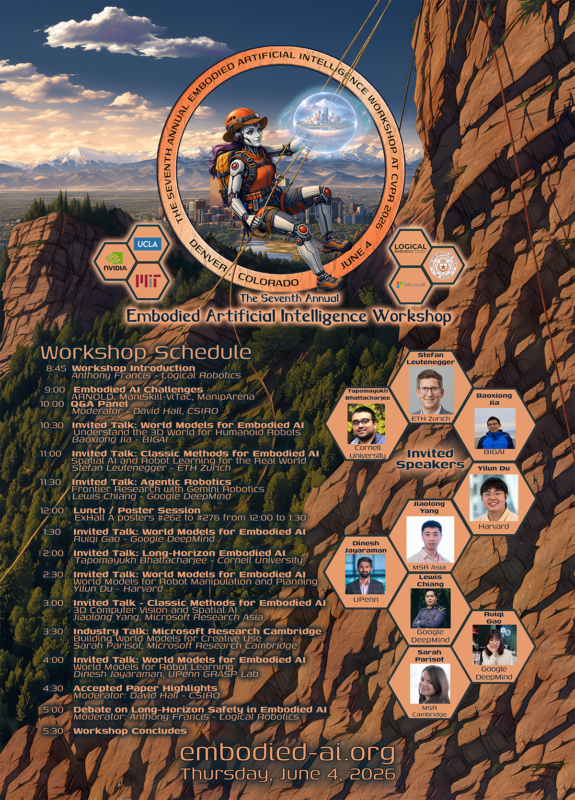
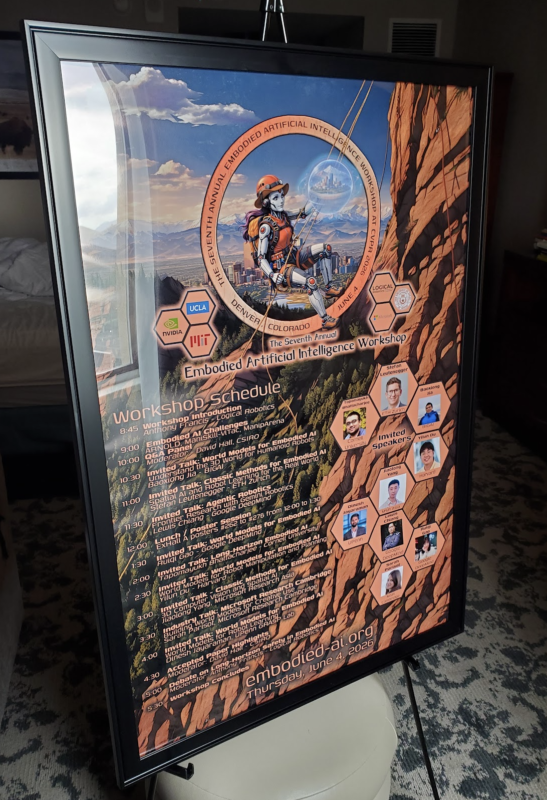
I'm promising myself not to over-complicate this post, so here's the short story: it went well! But we were making changes up to the previous day, so between the time that we printed the above poster and the actual talk, two of the speakers had changed - one speaker replaced their own backup, and another speaker who had dropped out was replaced by a volunteer speaker the afternoon before!
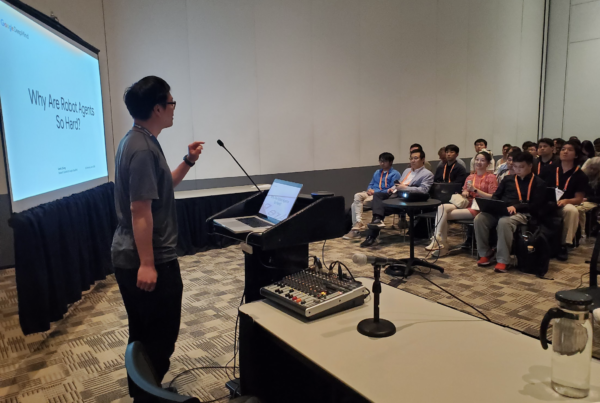
As CVPR (our parent conference) said, "Printed materials may be out of date ... check the website!" Which we did keep up to date: https://embodied-ai.org/cvpr2026 ... overall, though, the workshop was well attended. The best attended talk was my buddy Lewis Chiang's, a roboticist at Google DeepMind who I always thought was a superstar and I guess he's well on his way:
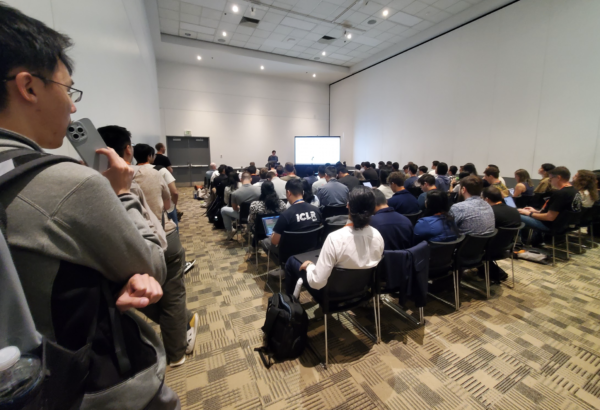
Over 70 people attended the talk and at least a dozen people were remote. While there were a few open seats up front, it still created a standing-room-only vibe:
All in all we had nine speakers, two highlight sessions for embodied AI challenges and accepted papers, a poster session, and a concluding debate. The very first picture is me, Lewis and Dinesh, another speaker at the workshop, discussing the nuances and challenges of safety in long-horizon embodied AI - a fancy way of asking "how to keep our agents from killing us if we let them loose."
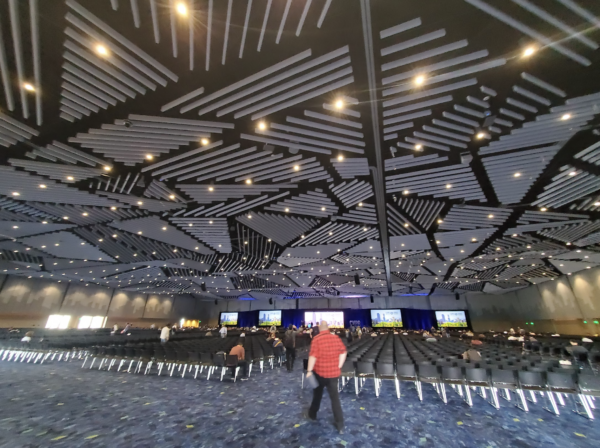
There's more to say about this - CVPR is huge, so huge that it perhaps it was a mistake to go see the Backrooms movie after wandering around the massive Colorado Convention Center:
But, the long and the short of it is, we survived!
And now it's time to enjoy the rest of the conference ... at a much slower pace.
-the Centaur
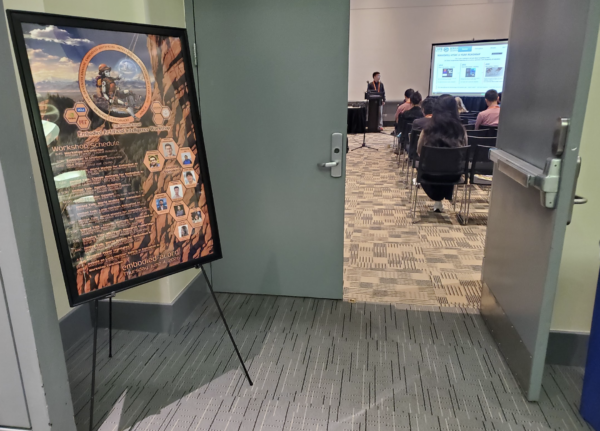
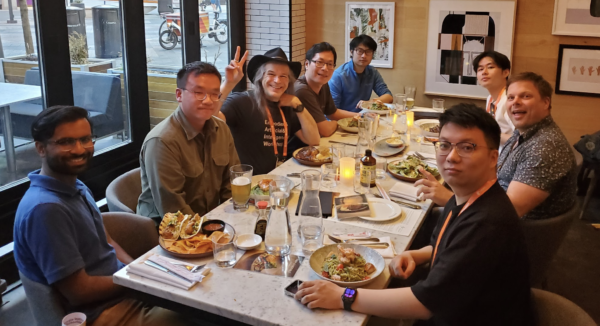
Pictured: the final debate, the image of the schedule poster, the schedule poster in action, Lewis's talk, the standing room only audience, the keynote rooms, the expo floor and CVPR's massive collection of posters, the EAI7 dinner, and me in front of the expo proper. Now it's time for a nap.
The Embodied AI Workshop starts in just under an hour at Room 107 at the Colorado Convention Center! Hope to see you all there, or you'll all be square.
Well.
All of you wouldn't fit in the room, so I guess you don't have to be square if you're not there. But you can find out more about it here: https://embodied-ai.org/cvpr2026/
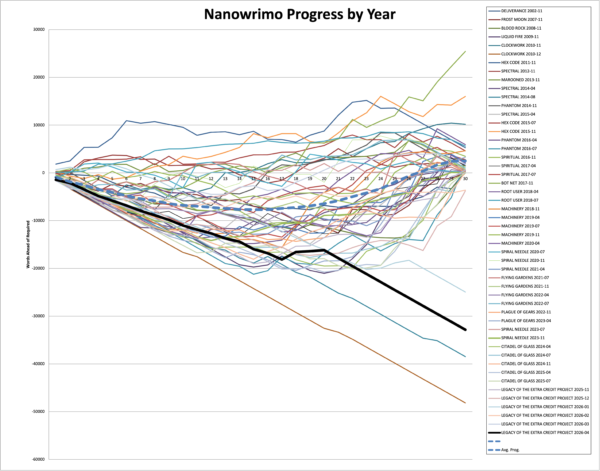
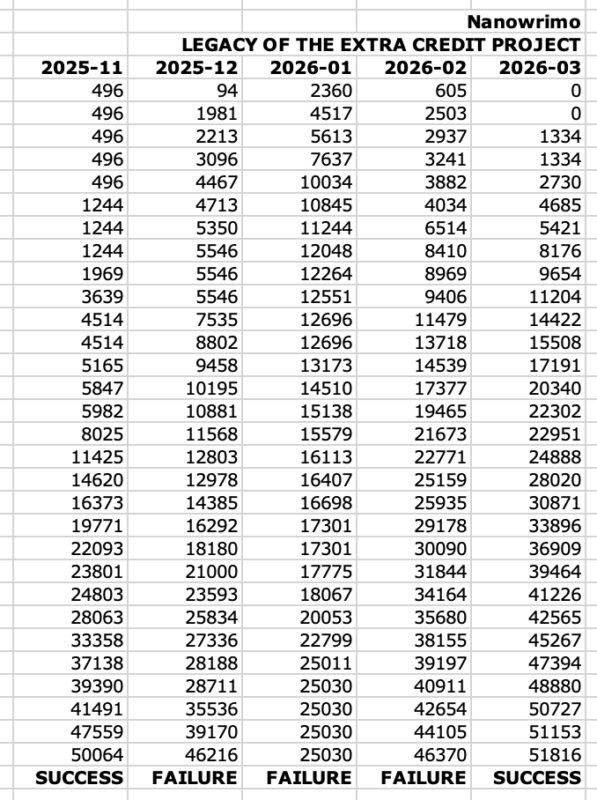
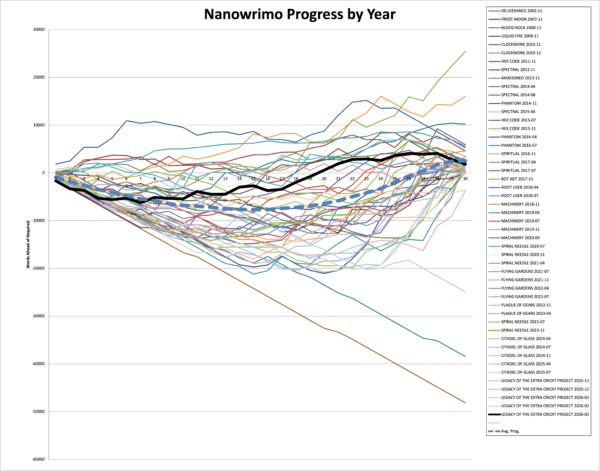
SO! My fiendish plan to drill in on finishing LEGACY OF THE EXTRA CREDIT PROJECT, rather than Blogging A to Z, has paid off in the nick of time: I just completed my forty-fifth successful Nanowrimo challenge, out of fifty total attempts over the past quarter century.
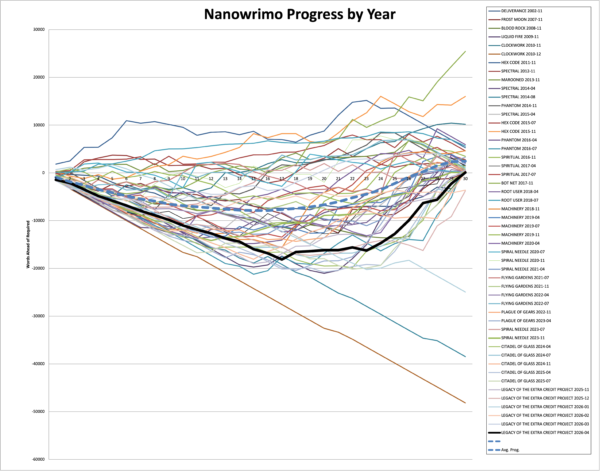
You have to look closely to see all the failures, but they're the ones that go down and to the right below the midline of the diagram you see above. But this time I made it, and just in the nick of time.
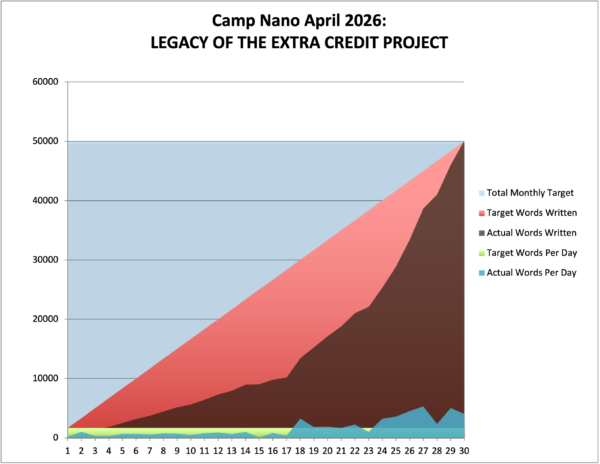
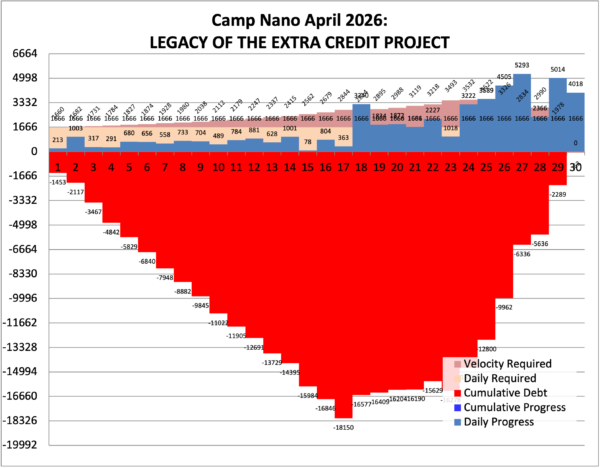
You see how steep it gets near the end? That's me doing a full court press, right in the last week. That's always a less fun experience than I like, but I have to say, sometimes wonderful things come out of it - in this case Kassandroc, a "prophecy bird" who popped into Novella 7 in the sequence in rather late and complicated it in some very delightful ways.
But getting there required putting in several 5000+ word days, including staying up to six in the morning the night of the 29th (which basically was today) to make sure that I had fewer words remaining on the 30th than I had written on the 29th, essentially knowing "I can do this!"
And I did. I've hit 292K words in the manucript for LEGACY, which has turned into a trilogy at this point, divided into roughly three to four novellas per book. That makes LEGACY my largest writing project, longer than the MACHINERY OF THE APOCALYPSE, another unpublished trilogy which I am looking forward to getting back to once I finish LEGACY and release it to the world.
And now, I have a very late IROS review to do, which I just found out about because apparently the reminder emails were ending up in my spam folder. More in a bit!
Oh! An excerpt. Context is for wimps:
Like so many names in Arcadia, the Origami Gryphon was both a shop and a person.
The Gryphon’s shop was located on the intersection of Fourth Spoke, Fifth Ring, not too far a walk from where Darina and Q’yagon first met. Then, as now, the Origami Gryphon was a sprawling scrollarium, a vast disc-shaped building wider than Helixium. Three steaming water towers surrounded a central rotunda filled with books, slates, scrolls, and encyclitomes.
Inside the main entrance hung a massive, ornately engraved sign—the original sign for the shop, a millennium old, now roped off with its own historical marker, but still legible in pre-post-post-post-post-modern-styled ornate Roman English lettering:
Welcome to the Origami Gryphon Books Eaten, Scrolls Written A Million Books of Lore Ready to be Regurgitated All You Need is a Question
“And some coin,” Q’yagon cracked, patting Darina’s arm.
Onward!
- the Centaur
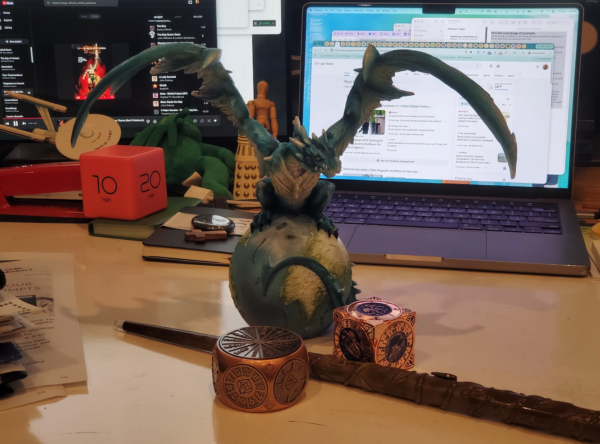
Pictured: a statue I found at SC Comic Con, which, I swear, looks almost like the ice dragon Frostthorne from LEGACY, complete down to standing on a modified globe which had some of the features of the post-continental-shift world of the Spookymurk.
So my next thought on the Blogging A to Z Challenge for 2026 was, if I failed at that challenge but succeeded at my National Novel Writing Month challenge to write 50,000 more words on THE LEGACY OF THE EXTRA CREDIT PROJECT, what would happen?
Why, I'd notch one more victory on the above diagram. Specifically, that dark line going down and to the right would tilt up until it intersected the convergence of lines above - which would put me at something like 290,000 words on LEGACY OF THE EXTRA CREDIT PROJECT.
Nanowrimo, for those just joining this blog, is a challenge to write 50,000 words of a new novel in the month of November. It expanded into "Camp Nano" challenges in April and July, and I personally, since I write long novels, use it to add words to manuscripts in process.
About ten years ago, I started doing the Camp April and July Nano's, since I wanted to finish my books before I die, and last December, I started doing the challenge full time until the end of the LEGACY OF THE EXTRA CREDIT PROJECT ... which is turning into a damn trilogy.
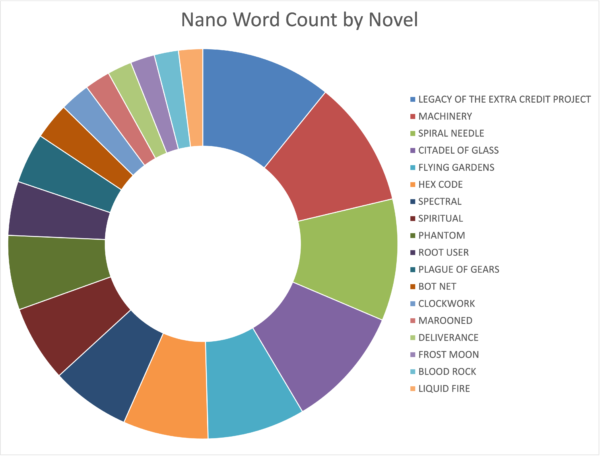
So far, approximately 10% of the words I've ever written in Nano were on this one project. I have a lot of work to do - I'm just finishing Novella 5 out of a project 10-12 novellas, and boy does it need editing - but I'm very proud of some of the work that I've done here.
So if you don't see me blogging, that's because I'm writing, drawing or coding.
Mostly writing.
-the Centaur
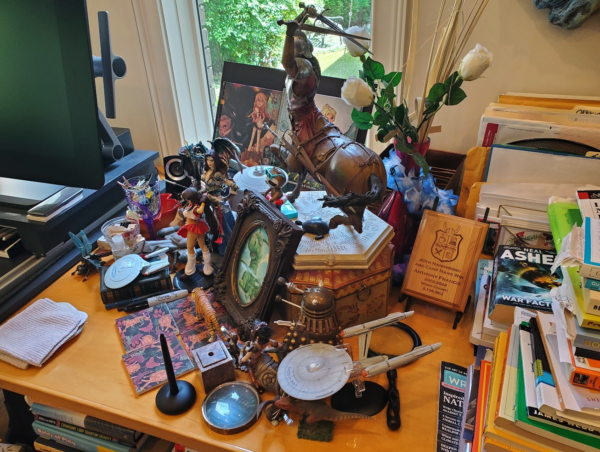
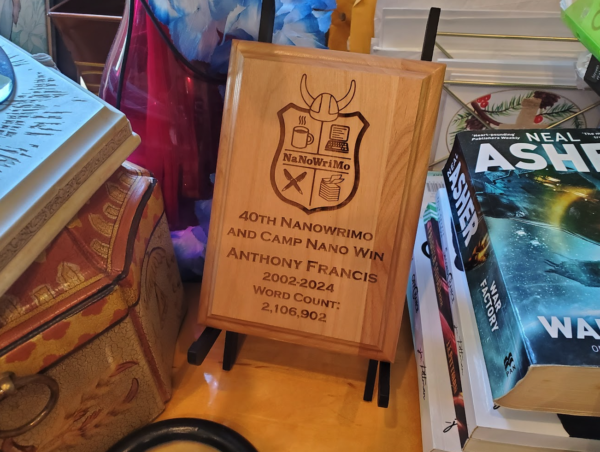
Pictured: My "the reason you're doing this" shelf - a collection of genre toys and personal keepsakes I use to remind me of why I work. Also pictured: my Nano yearly stats for the past quarter century or so, and the plaque I got from the now-defunct Nano organization when I cracked 2 million words.
So, recently, I asked myself the question: what would be the outcome if I failed to complete Blogging A to Z in April of 2026, but I successfully paid my taxes and filed for an extension in a timely fashion?
The answer: I'd have to pay less of a penalty for NOT getting my taxes done on time.
Having worked in a startup, at a large company, as a contractor, and between me and my wife owning five small businesses, our taxes are ... complicated. Add to that many of the people we interact with not getting us forms until I've already left to attend the Game Developers Conference, I get them done late every year.
Every year, even though I have a formalized system for collecting receipts, and a structured spreadsheet for collating information, there's SOME damn thing that requires me to spend hours extracting information from one program or website and reformatting it into tax-friendly data in an another.
I thought I'd be done three weeks ago. Then last week. Then this weekend, where I set aside all of Sunday to "finish up". At 3AM or something, I gave up, deciding to scan the last forms in the morning.
BUT, this time I was right. There were only three or four things left to scan, the scanner worked, and the data was successfully uploaded to our accountant. We'd expanded our spreadsheet last year to enable me to compute what we owe - paying your tax is a prerequisite for filing an extension.
We paid the tax. Our accountants filed the exception. And then I went out to an impromptu dinner with friends, where we talked about writing.
It was a pretty good day.
-Anthony
Pictured: A custom cocktail at Select restaurant - a mezcal Old Fashioned, I believe.
Postscript: I forgot to say, Blogging A to Z will resume TOMORROW, after I'm caught up on other stuff.
"Discretion" is sometimes defined as "the freedom to decide," as in "a judge exercising their discretion" or the related sense of "speaking with care," as in "a confidant's discretion can be relied upon." These are closely related, in my mind, to "discernment", the ability to judge well, a word which has been co-opted in Christian circles to refer to examining things without immediate judgment to obtain spiritual guidance.
But when I mean discretion, I mean taking each situation case by case and applying one's best judgment without relying on pre-decided rules, as a method for dealing with the inevitable limitations placed on us by Godel's Incompleteness Theorem - or, in plain English, exercising your judgment because rules will fail you.
A theorem is something that's always true whether we want it to be true or not. "Two plus two is four", believe it or not, is a theorem, communicating the idea that A(S(S(0)),S(S(0))) - in English, "plus two two" - is S(S(S(S(0)))) - in English, "four" - because of the definition of A(,) - in English "plus". There are times when the theorem isn't appropriate - for example, trying to "add" merging clouds - but you cannot escape it.
The fancy-sounding concept "Godel's Incompleteness Theorem" is a theorem, and in English it means that rules will always fail you by being wrong or incomplete. Its formal statement is about the "incompleteness" of any system complex enough to do arithmetic, and its unprovable consistency. The mathy version of it runs a dozen pages, but shelves upon shelves of textbooks have been written on its implications.
But in practical terms it means that no matter how complex the set of rules you create, either that system must inevitably fail to cover some case, or it must contain mistakes, or it must be so trivial as to be useless. Which means that no one - no priest nor politician nor administrator nor ordinary people trying to manage their own lives - can come up with a set of rules that will always work.
That means we must always exercise our discretion. This is a dangerous thing. Christian theologians love to argue that people love to rationalize, to come up with explanations that justify their misbehavior; but this does not prevent the rules those theologians come up with from failing.
I myself am fond of saying that in a world with imperfect information, decisions cannot be made reliably based on the information that we have in front of us, and that we have to rely on policies that extend beyond those immediate situations; but even those policies may inevitably fail.
But the possibility of failure does not absolve us from the responsibility of trying. To do the best we can in the world, we need to think back - and think ahead - and come up with the best rules that we can, so we don't get fooled by our own desires or the appearance of the situation in the moment; but in the moment, we must also apply our discretion, keeping a careful eye out for conditions that undermine the assumptions behind our clever rules and force us back to the drawing board for a new look.
This process of exercising discretion is fundamentally human. I don't mean the emotional statement "oh, this is a basic part of the human experience" - though it is that - but actually a more technical statement of how human cognition works: it's a part of how we think called universal subgoaling and chunking.
Normally when we think we're actually deploying many learned rules extremely swiftly to make progress, an experience of flow that we find effortless. But when the cognitive engines we call our "minds" reach an "impasse" where we don't know how to move forward on our goals, we generate new "subgoals" to resolve those impasses, marshalling all the knowledge we have to try to solve the problem. It's a difficult, effortful process, prone to failure; but if we do succeed, our brains store this solution as a new "chunk", a new if-then rule which we can use to think more swiftly and effectively in the future.
[As an aside, one of the actual differences between modern "AI" and human thought --- or, more properly, between modern LLMs and so-called "cognitive architectures" modeled on actual human thinking --- is that the LLMs are explicitly not set up to do this. Their learning process is much more akin to acquiring a lot of crystallized rules, or to manipulating those rules in a limited workplace in something akin to subgoaling, but they generally are not set up to do chunking. In a way, we don't want them to; we don't want chunks from my chat session leaking into your session, giving you my answers. But diving into how almost every critique you've ever heard of modern "AI" is a load of dingo's kidneys would be too much of a digression.]
In a sense, we as people and systems are often not as smart as our own brains trying to solve problems, relying too much on fixed rules, societal norms, past traditions, and unjustified feelings than our own brains, which have the advantage of being able to immediately tell whether their if-then rules are failing to give them the answers we need (whether those are the right answer is another question). It takes a deliberate effort to make sure we're not running on autopilot, and all too often, we stick to the rules for no reason.
Don't do that. Look at the situation; exercise your discretion.
You, and the world, will be better off if you do.
-the Centaur
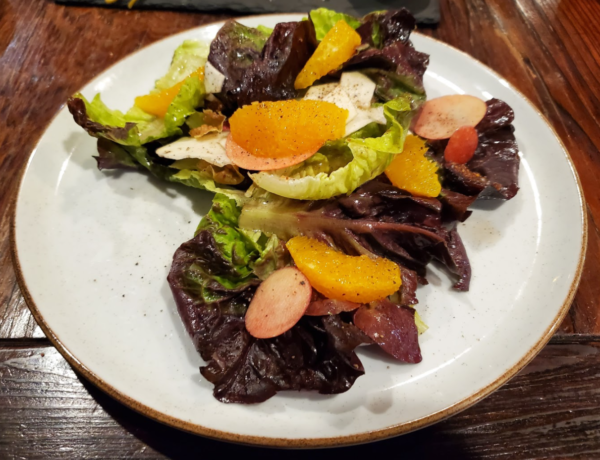
Pictured: Discretion is the better part of valor when spending a vacation with my wife in a town with a lot of good vegan food options. After several days of overeating ... I had a salad for dinner tonight at Craft Roots, because I knew my wife was going to order chocolate mousse with ice cream for dessert.
SO I was looking at the rules of the Blogging A to Z challenge and came to interpret it to to mean that all the posts should be organized around a topic. Reading the rules more closely, I don't think that's the case: "You don't have to change your format of what you normally write, just come up with topics that correspond with the letter of the day." Regardless, I know some people come up with a unifying theme, and I did so:
My conceptual library - or, more particularly, conceptual library curation.
Many great thinkers had to develop their own language to help them articulate their ideas - Immanuel Kant, Ayn Rand, and so on. I don't know that I'm a great thinker, but I frequently find myself relying on a private vocabulary of ideas that help me understand the world. Some of these I've gotten from other people - like "autistic inertia" and "bullshit" - whereas others, like the "Gaimannian Landscape" and "value collapse" are my own inventions.
Others, unfortunately, I can't share - such as the ideal C entry for today, a phenomenon we might call "prestranglulation," or strangling a project by drowning it in unnecessary prerequisites. You'll note that's not the actual word, which starts with a C - but the private word I use for prestrangulation is based on the name of someone I know who does it, and, out of respect, I'm NOT going to shame them publicly by coining a term based on their name and blogging about how bad that behavior is.
Instead, you get this post, about the importance of articulating your own conceptual library, acknowledging or tracking down where those concepts came from, and challenging those concepts periodically to make sure they still make sense.
Some of my most cherished ideas don't work. For example, one idea I picked up is that "you shouldn't critique during a brainstorming session". As it turns out, this idea, while it goes back far in brainstorming research, is at least partially bunk - totally off the wall ideas can derail brainstorming so a limited amount of criticism can actually be helpful. Other ideas I've had on my own similarly didn't stand up for scrutiny.
One way that you can challenge your own ideas is to name them, to attempt to define them more precisely, and once you've done so, start seeking evidence that supports them - or contradicts them.
Contra what you may have heard from naive takes about the scientific method, a scientist should not start their investigation by trying to prove an idea wrong. First you have to have SOME evidence that an idea MIGHT be right, or you'll end up wasting your time trying to refute every idle speculation that you have.
But, conversely, you are the easiest person to fool, and once you have an idea that you think might be true, it's easy to get caught in confirmation bias, where you only look for confirming evidence and don't look for evidence that contradicts your view.
So, as part of that exercise, i hope to spend a little time this month not just blogging ideas, but subjecting them to a little bit of criticism.
-the Centaur
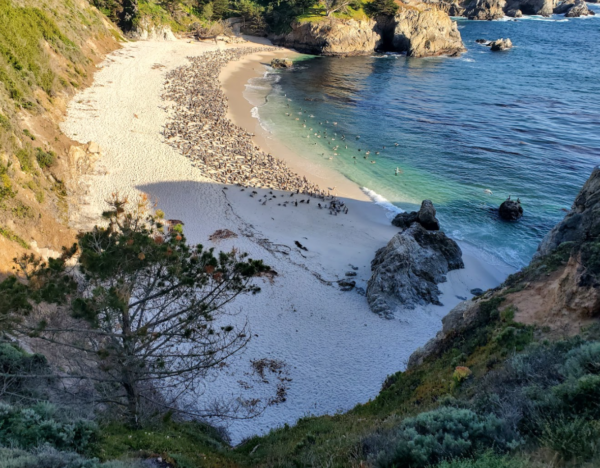
Pictured: birbs, at Point Lobos, who happened to make a shape like a "C".
One of the worst things in the world - not the things that feel bad to me, but things that are bad for others - is the pernicious phenomenon of bullshit - and I don't mean crap from a bull, but the kind of crap that comes out of people's mouths when they're trying to sell people a load of crap.
This kind of bullshit is a particularly pernicious kind of lying - a kind of lying so bad that philosophers aren't even sure that it's lying at all. A liar, after all, envisions a model of a world better for them than the one we live in, and deliberately tries to falsely impress that model into in the mind of their hearers.
But a bullshitter doesn't care about true or false at all: they just care about creating an impression. I recall running into a bullshitter at a friend's party once who claimed "there are no Native American vegetables" and when I later came back with a list (it's a long list) he blew this off as irrelevant.
Because he wasn't concerned with the truth. He was concerned with holding court. He was a loud, showy, know-nothing know-it-all, who was constantly trying to find ways to dominate the conversation at this particular social grouping. He didn't care about the facts - he just cared about being the center of attention.
I didn't care to go to too many of those parties. :-)
It should be obvious that bullshit has corrupted American politics. While both ends of the political spectrum can fall victim to it, our current leadership is bullshitting dangerously about everything from the legal justification for their illegal actions to the strategy behind their irresponsible wars.
And the bullshitters I know personally have given away the game on this. They have repeatedly said things like, "the only reason you're raising that objection is that you oppose what I'm trying to do". No, no, my friend, you have it backward: we're opposing what you want to do because of those objections.
We do not live in a world defined by different movies running in different people's heads.
We live in exactly one shared world, where there are facts to matters to which appeal can be made - exactly one shared reality which we cannot fake in any way whatever, and if you try, sooner or later, it will bite you.
-the Centaur
Pictured: A path in our yard choked by invasive succulent plants. They grew from cuttings which we got from local plants that thrived in our dry climate; we didn't know they were invasive when we planted them. I guess they showed us. Invoke what symbolism you can from this about bullshit in public discourse.
Two of the "worst things in the world" for me are writer's block and autistic inertia. These aren't objectively the "worst things," like panic attacks, ear infections or failure to use the Oxford comma, but they are some of the things that feel the worst to me in the moment.
Writer's block, the inability to write, can get so bad it can drive people to suicide - notably, Ernest Hemingway - and I myself remember lying on the floor of a research office at Google for hours, unable to start work on with a paper I wanted to write, knew how to write, and had already written the outline for.
I eventually wrote that paper (and if I recall correctly, it was published here) but it is true to this day that I can be writing gangbusters on one project (240,000 words on Legacy of the Extra Credit Project) but can get completely stymied on switching gears to another (such as a Prosocial Robotics paper back in January).
That's why, for me, I suspect that writer's block is a subspecies of autistic inertia. Autistic inertia is a phenomenon documented in the autistic community where people "on the spectrum" like me have a marked difficulty starting or stopping tasks.
For example, blogging.
For me, this applies not to just technical things, like writing scientific papers, but to anything that involves interacting with people, like social media or even just sending emails. Recently, I had trouble sending out social media posts for the Seventh Annual Embodied AI Website even though I'd already drafted the text.
That increased social factor makes me suspect that my autistic inertia is also tied to my social anxiety disorder - that weird miscalibration that I have which makes many simple social situations difficult to initiate and stressful while they're happing.
Regardless of the cause, I often find myself unable to start tasks that I want to start, or unable to stop work on something that I feel that I should put aside. This can mean that one task, like, say, writing a novel, can steamroll a variety of other tasks, like, say, blogging.
So I thought I'd share that: one way to overcome the worst thing in the world is to find a structure that forces you to get onto the path of conquering it.
-the Centaur
Pictured: the bathroom in our San Jose home, which we had renovated during the pandemic, and my wife painted after the pandemic, but which we dallied for a long time on installing towel racks. On our most recent trip out here, I got tired of stacking bath towels atop the toilet (gross!) during the shower, and forced myself to (a) track down the fixtures we used in the bathroom (discontinued!) (b) seek out an alternative (c) buy them and (d) install them before my wife was scheduled to arrive. And when I was done, I asked ...
Into roughly 240,000 words of LEGACY OF THE EXTRA CREDIT PROJECT.
As I mentioned back in November and December, I've been working on a "cozy fantasy" called LEGACY OF THE EXTRA CREDIT PROJECT that I first started writing in roughly February of 2010 (under the title "The Eternal Crypt of Endless Night: An Oakholme Properties Dungeon"), but which, according to my notebooks, I apparently put aside when I received edits on my second Dakota Frost novel, BLOOD ROCK.
Life got away from me at that point. FROST MOON came out right around the time I put LEGACY OF THE EXTRA CREDIT PROJECT down, and in addition to its publicity, I was hard at work at Google on a major project that itself soon got sidelined when I had a chance to join Google's first Robotics effort.
FROST MOON. BLOOD ROCK. "Steampunk Fairly Chick", the first Jeremiah Willstone story. The Google Scanned Objects effort, and the DOORWAYS TO EXTRA TIME anthology. Then LIQUID FIRE, the Replicant robotics effort, THE CLOCKWORK TIME MACHINE, and Robotics at Google proper. All good times.
By 2012, I had completely stopped revisiting THE LEGACY OF THE EXTRA CREDIT PROJECT, and by the end of the decade, I had aaalmost forgotten about the stories of Q'yagon the zebra elf and Darina his spidaur girl ... until 2022, when Travis Baldree's cozy fantasy novel LEGENDS AND LATTES came out.
LEGENDS AND LATTES wasn't the first cozy fantasy, which in a sense goes all the way back to THE HOBBIT, but it is the lightning bolt that revitalized the genre. An orc swordswoman retires and opens a coffee shop. That's the whole book; that's all that it needs. The sequels, BOOKSHOPS AND BONEDUST and BRIGANDS AND BREADKNIVES, are even better; but there's a simple perfection in a giant barbarian swordswoman realizing that she's going to need to put up a "Seating reserved for paying customers" sign.
So, for my November Nanowrimo project (that challenge to write 50,000 words in the month of November, formerly shepherded by the now-defunct nanowrimo.org organization and now loosely led by nano2.org ) I restarted LEGACY OF THE EXTRA CREDIT PROJECT ... and didn't stop at the end.
Now, I had never successfully completed a Nanowrimo-like challenge except in the official months of the challenge - November (Nanowrimo), April and July (Camp Nanowrimo). You can see my first two attempts, in December of 2010 (on THE CLOCKWORK TIME MACHINE) and August of 2014 (on SPECTRAL IRON).
At first, this time was no exception. December was decent, until I stalled out in the holidays. January was much worse because I had a scientific paper (and the underlying code and experiments) to develop in a very short time frame (I had done six months of prep, but eventually, the rubber meets the road).
But I was very happy with that progress; I was even planning on writing a blogpost on "85,000 words of successful failures". But, instead, I deliberately chose to buckle down and to try to "finish" THE LEGACY OF THE EXTRA CREDIT PROJECT, which I was confident I would be able to finish in a month or two.
That was before I discovered I was writing a trilogy.
Or whatever the hell it is. I'm structuring LOTECP as a sequence of novellas, each roughly 20,000-30,000 words long, which I hope to release as separate volumes; very roughly speaking, four of those novellas are roughly novel length, and it looks like I'm going to have about 12 or so of them by the time I'm done.
Another darn trilogy.
But I pushed through, and got close to my 50,000 words in February (a short month at that!) and nailed it in March. As of tonight, the last day in the 30-day challenge, I have written 51816 words on LEGACY in March and 242038 words (counting outline, notes, and such) in total.
So, as much as I love blogging, I think that's a fair exchange.
And now! A brief excerpt, from the very beginning of the project:
“In a time before the story started,” intoned the wild-eyed, wild-haired sage, “in a land far from those we shall travel—” he glanced around the faces lit by the flickering fire: fighter, mage, healer, rogue “—among a people whose deeds are spoken of only in legend—”
And in an accent so thick, thought a figure in the dark, it could be used as plate armor—
“—events transpired so portentous, so critical to our quest,” the wizened sage said, gesturing expansively to suggest realms and vistas of staggering, nay, even plot-significant importance, “that we cannot even begin without an accounting of them … in full.”
The fighter carelessly spat her chewed gristle into the magical fire. The rogue leaned against the corridor wall, slender ears carefully listening. The healer carefully applied a bandage to the mage’s hand, where he’d carelessly burned himself trying his turn at the cooking.
The sage boomed, “And so—”
“What are you doing?” asked the striped shape emerging from the dark.
“Drakespit!” The rogue jerked back, drew his knife, and tripped over a rock.
“This is a corridor, friends,” the striped shape said—and what a strange person: an elf, clearly, in the dark leather armor of a low-level minion, but his mane of hair and even skin were striped like a zebra—and did his stripes glow? “Camping here is an OSHER violation.”
I'm having a lot of fun with this one.
Hopefully, I'll finish this in 2-3 months, then start releasing the chapters on my Patreon.
Oh. A Patreon is coming. Just thought you'd like to know.
Onward!
-the Centaur
Pictured: the word count table for LOTECP, and the nano yearly comparisons for the past 24 years.
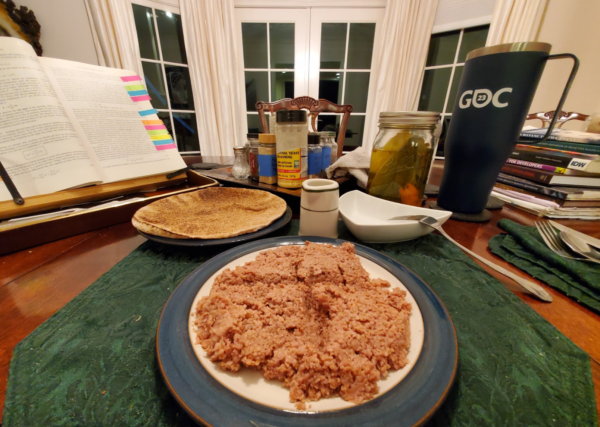
I am pleased to report that vegan kibbey nayye continues to be a hit. My wife had left a white onion in the fridge when she left on her last business trip, I had a pound of vegan hamburger in the freezer and a bag of fine bulghur wheat in the fridge, and there was a snowstorm threatening to snow us in all weekend. So I made some vegan kibbey nayye, and it turned out quite well.
Differences on this outing: I washed the bulghur wheat three times and soaked it in the absolute minimum amount of water, I drained the excess onion juice off the ground onion, which I think improved its texture. I alternated a big spoon and a potato masher rather than hand mixing it this time (more out of paranoia and fastidiousness than anything else). The spices, remarkably, I got right the first time: a decent amount of salt, somewhat less pepper and cumin, a little bit less cinnamon, and even less allspice. It Just Worked(TM).
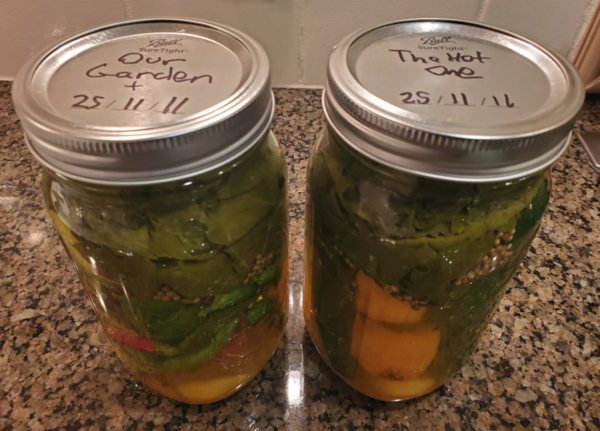
Combine that with some thin lavash bread in the freezer (which I am getting better at the technique of flash-defrosting with 30 seconds in the microwave and an equal amount in the toaster) and the increasingly good pickled hot peppers, which are only improving as they age, and a little Filipio Berio olive oil ...
And that was a pretty good meal --- actually, a few meals, over 2-3 days.
-the Centaur
Pictured: vegan kibbey nayye, lavash bread, olive oil, pickled hot peppers, and the reading pile.
So at nearby Furman University there's a man-made lake with a variety of waterfowl in it - including a pair of black swans, which happen to sound a lot like kittens. Apparently these are Australian imports, deliberately introduced to the lake, and are well known to sightseers and university residents alike.
We saw the swans while walking around the lake, trying to work off some of the wonderful vegan food we had at nearby Sunbelly Cafe, a vegan, gluten-free restaurant that nevertheless has really great food.
My wife had our usual favorite, their vegan burger with all the addable fixin's, but I tried their all-day breakfast and found their waffles were quite the standout.
So was the vegan dessert.
It was a pretty good day.
-the Centaur
Pictured: the black swan, the lake, the waffles, and the dessert.
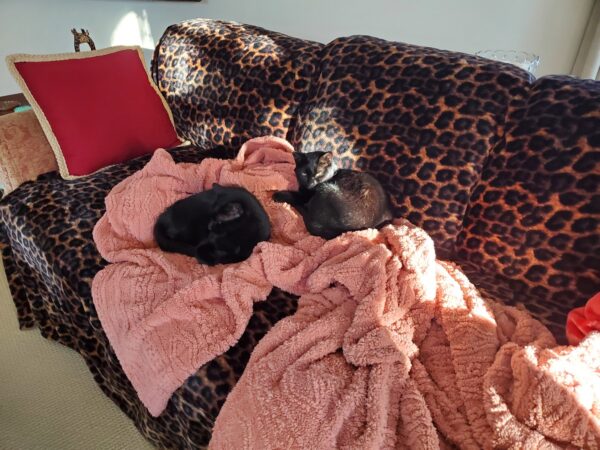
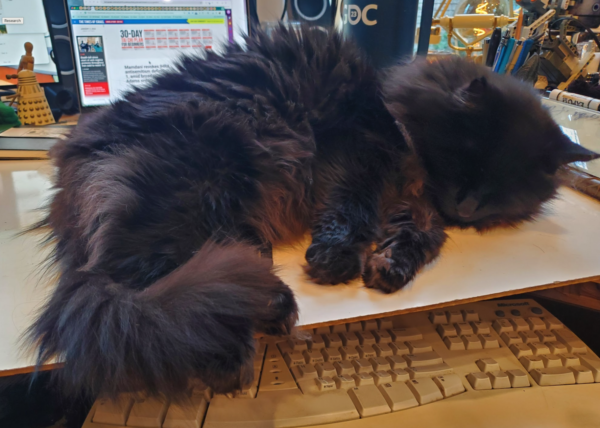
To get things rolling again, I present two cats sunning in a sunbeam, on our sofa, amidst my wife's art and furniture (and furniture that we inherited from my mother).
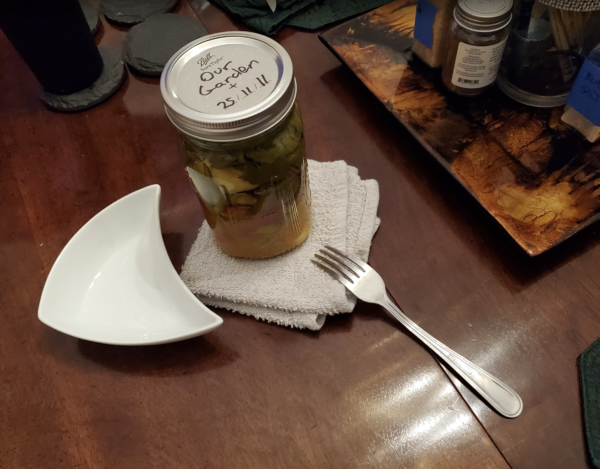
Sandi and I talked a good bit about how to improve my Lebanese pickled hot peppers. I have been having 1-2 of them, plus one of the grape-leaf toppings, with our squash+mujuddara meals for the past few nights. The hotness is OK, but the flavor could be better, but the real problem is the texture: the first few peppers were too crunchy, which itself isn't at all a bad thing, except it wasn't what I was trying to recreate.
Dad's hot peppers (well, probably Mom's hot peppers, but made to Dad's exacting but poorly-articulated specifications and executed with Mom visiting Aunt Nagla, Aunt Kitty or Aunt Theresa to get the skinny on the recipe, because that was how they all rolled) were hot but not too hot, soft but not squishy with a little but of crunchy, vinegary from their brine; and well-preserved enough to be stored in the kitchen cabinet.
I have been in the hospital from food poisoning too many times to put anything in the fucking kitchen cabinet, no matter how well preserved. For those not in the know, I have been in the hospital at least twice, and probably three times, with food poisoning so severe that I became dehydrated enough to require a saline IV. And I realized that the common factor in every triggering event was getting a bit of food that was slightly off in some way, and eating it thinking, "Naaah, it will be fine."
Yes, food that tastes weird may just be food that tastes weird, but after the third such incident, I deployed one of my Rules(TM) to put a stop to that. My Rules(TM) are things I use to prevent me from going down a path which might get me into serious trouble down the road. Some of my Rules(TM) include: never gamble for money (with exceptions for <$20 dollars in a slot machine if waiting around while friends are gambling at a casino), a one drink per day limit (with a rare second drink several hours later, such as a nightcap if the drink wasn't strong, a late evening cocktail after a margarita at an early lunch, or a drink in a circumstance when you know you're not driving, such as a plane flight or a hotel bar after a long plane flight). And another Rule(TM) is "If anything seems off with some food, don't fucking eat it, full stop --- literally no exceptions."
So my pickled hot peppers go in the fridge, and that leads to the first potential diagnosis of the crunchiness problem: rather than 1-2 months pickling in the cabinet, maybe they need 3-5 months pickling in the fridge. Another might be letting them dehydrate more; Dad's pickled hot peppers were pretty soft, and Sandi's mom Dottie suggested letting the peppers dry out longer. Using Sandi's dehydrator or mild roasting might achieve the same effect of drying the peppers out so they'd absorb more brine and making them softer.
Also, I think I'd radically up the spice in the brine, adding more turmeric and garlic and coriander seeds, which seem to have been a whole net positive on the appearance and flavor of the hot pepper mix. It's entirely possible that dehydrating / drying out / roasting, jazzing up the brine, and perhaps going full non-refrigerated canning ritual with boiling rather than salt/vinegar fridge canning with mere jar sterilization, would yield better results.
But all of this, note, is unscientific; or, more properly, is what classic thinkers would have called science and modern thinkers would have called art: examining a situation, rationally analyzing it, and then applying the results of that rational analysis to suggest a next alternative. That procedure sounds great, and it sure suckered the Greeks, but it's total bullshit. In real life, you do not fucking know whether the ideas you have extracted from past events will apply in future circumstances, and the only fucking solution is to simply try them, record the results, and attempt to generalize over many instances, hoping that what you think you have learned is not an artifact of random noise.
That's depressing, in general, and doubly depressing for professional scientists. Most of the questions we want to answer in our daily lives are not amenable to the methods of science because the events in question happen too rarely to get statistically reliably conclusions (and before you protest that you are actually "scientifically" testing your ideas, let me point out that you need roughly 30 trials in each major bucket of analysis, good or bad, to have statistically reliable results, and I can virtually guarantee you're not conducting 30-1000 trials for most of the things you think you have learned in the course of your life).
No, we instead rely on our innate learning: the gut that Jim Kirk relied on, Spock mocked, and McCoy understood the wisdom of. We've got three point five billion years of evolution underlying our learning systems, so when humans learn things, the results of our learning aren't bad.
But a rule of thumb is not validated knowledge.
The only solution is to have humility, accept that we can be wrong, and to try, try, try again.
So I'm going to keep canning Lebanese pickled peppers until I get it right, is what I'm saying.
-the Centaur
Pictured: the pickled peppers, in their intended deployment at a meal.
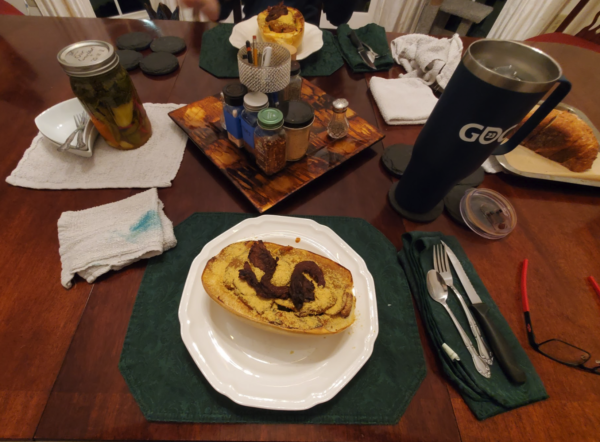
I am unlikely to become a vegan, but I do enjoy vegan food, and one special time for vegans is the winter, in which many wonderful squash are available for vegan dishes. My wife has developed a wonderful "formula" for vegan dinners which involves a squash (today, spaghetti squash), a filling (today I think mujudara, a rice and lentil Lebanese dish she picked up from me and ran with), a topping (mushroom jerky and mushroom marinara sauce) and some kind of bread or pasta (today, vegan sourdough from Whole Foods).
An assist on today's meal are some Lebanese pickled hot peppers that I made which are ... okay. The recipe I used said they'd be ready in about a month, but these are one and a half months old and they're not too pickled so far. Flavor is fine, not too exciting, but the ones my mom and dad made were always a bit more pickled and soft, whereas these are still crunchy. I'd probably research whatever it is that makes them more soft and do more of that, and probably up the amount of spices (turmeric and garlic and more) in the mix.
But! A perfectly good meal.
Today's challenges included blogging (yasss, this post), drawing (1 drawing), writing (~1900 words on Tales of the Spookymurk), working on a scientific paper (on prosocial robotics), and some reading.
Also in today's news, America seems to be grasping at starting a Western Hemisphere empire, and to justify it, Stephen Miller demonstrated his lack of grasp of basic history:
“We live in a world, in the real world, Jake, that is governed by strength, that is governed by force, that is governed by power,” he said. “These are the iron laws of the world since the beginning of time.”
Real cute, Steveo, but ignorant. Since you're interested in the beginning of history - I know you said time, but I'm just going to interpolate what you really meant there, since it isn't coherent enough to be parsed on its own merits - you might look up the chaps Hitler, Napoleon and Alexander. The iron law of the world is that setting the whole world against you never goes well, and even if things seem to be looking up for you for a bit, an empire put together by pure force will fall apart as soon as it slips from a tyrant's dead fingers.
Realpolitik is neither real nor politic - it's a childish emotional response to situations which is directly contradicted by readily available facts. I'm prepared to justify that in depth, but then, the proponents of realpolitik generally don't know what it actually meant and are simply grasping at a word to justify their emotional desire to do something harmful and stupid that feels good to them, rather than, say, looking at what the actual consequences of pulling that bullshit on counter-acting actors generally turns out to be.
-the Centaur
Pictured: dinner with Sandi, and the pickled peppers when I bottled them.
Okay, today's post was going to be a post about friends and family and the value of organizing dinners.
Instead, I'd like to blog that it's late, and I'm tired.
Our five cats have not been getting along of late, and so we've separated the newest addition from the O.G.'s (the Original Girls, who actually aren't the original gangsters at all, but are the new(ish) kittens picking on the new(est) kitten). So, I was up super late socializing them yesterday, and am real damn tired today.
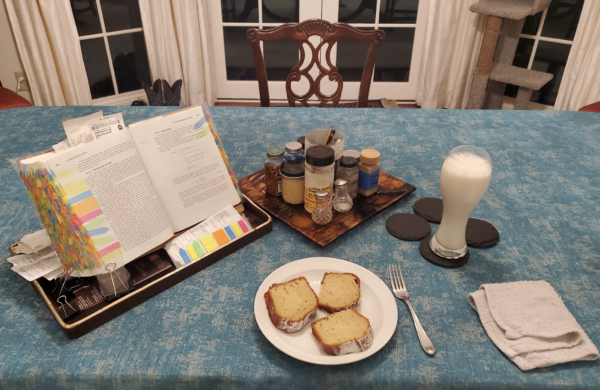
So please enjoy this picture of late-night pound cake and milk. Goodnight.
-the Centaur
Pictured: Pound cake, vanilla almond milk, and Pattern Recognition and Machine Learning, a fantastic, highly mathematical tour of machine, deep and Bayesian learning, my latest evening read.
Now, I couldn't do that when I started Drawing Every Day back in 2021, as I was a roboticist at Google working to bank up savings for me and my wife's retirement. But I could commit to doing at least one practice drawing, as I was already experienced at doing writing challenges like this blog and National Novel Writing Month. My notes say I got at least 215 days in to Drawing Every Day in 2021.
But I seem to have skipped it entirely in 2022, and couldn't pick it up again in 2023 due to the Google layoffs and me scrambling to finish the papers we had in flight and to get contract work. Only in 2024 did I start the project again, this time, getting at least 135 days into it (I say at least, since I may have drawings in a notebook that I did not yet scan for my records).
2025 was the year that I really buckled down and won it. Here are the rules that I followed:
The challenge starts in a calendar year.
The goal is to produce one practice drawing for every day in the year.
You can draw ahead as far as you have to to make sure you don't fall behind.
Ideally, your buffer should be at least a month, a week, and two days.
Drawings should be complex enough to take at least 10 minutes.
Any drawing you finish, in any medium, can count towards Drawing Every Day.
Conversely, don't pick a topic for Drawing Every Day too complex for a full 3 hour practice session.
"Retro" posts for missed days OR YEARS are allowed.
Success is doing a drawing for every day in a year before the year is over.
Completion is doing a drawing for every day in a year, regardless of when it is drawn.
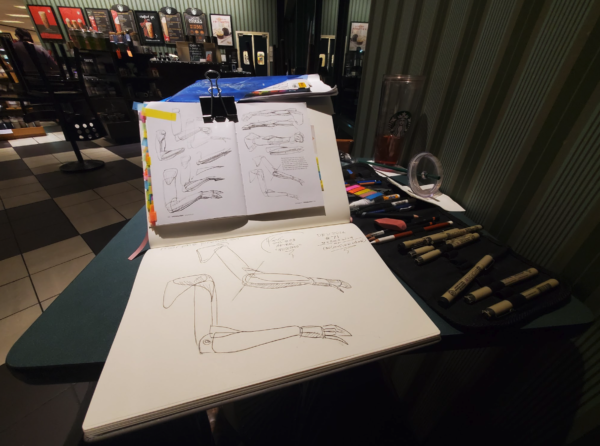
But there's more than that. There's one other trick: carry a portable drawing kit everywhere. So now, in the grey Google backpack that has my "portable office", I always carry a notebook, a small book of art instruction I can draw from, and a roll of sketching pencils, sharpeners, and erasers, and Micron pens.
With this, generally, I can allocate between 30 minutes and 3 hours to drawing on most days, but not every day. (For example, a day that you're sick, or flying or traveling, or the big friends and family Christmas party, are all days in which near zero drawing gets done). So building up a buffer is essential to finishing a year.
And once you've allowed building up a buffer, you can do more than that. The point is not to do a streak of consecutive days drawing; the point is having done one drawing for every day in the year - or, more precisely, doing a given amount of drawing practice in a year.
So first I started allowing myself "retro" posts when I got behind - originally, just for posting on this blog. But I decided it was more important to do the drawings than to blog them, and I focused then on building that buffer. Then blowing past the buffer. And finally, about October, blowing past the end of the year.
At that point, more than two months ahead, I had a choice: keep going until I finished my drawings for the year ... or start backfilling previous years. I picked the latter, allocating roughly two drawings to the future and one drawing to the past. This ensured that even if I lost a day, I'd still keep moving ahead.
I then blew past the end of 2025, and decided, rather than coast through the end of the year, I would just keep going. At this point, I'm over 90 days into 2026's drawings, and have around 120 to finish for 2024's. So as far as keeping the discipline up, I am feeling pretty good about this project.
Which is good, because around August to September, I wanted to give up.
After having spent much of 2024 and much of 2025 working on Drawing Every Day, not to mention the previous years, I started to feel my drawing wasn't improving. Frankly speaking, I wanted to quit, and seriously considered quitting as I was getting really busy around Dragon Con time.
But, I kept telling myself: you've been laid off. Your major consulting contract has come to a close. And you have time to write your novels. If you don't put in the time and the hours now, you'll never become a comic book artist, and the comic books that you want to write and draw will never be completed.
So I committed to finishing 2025. And as I did that work, I started, very slowly, to notice incremental improvements in my drawings. Feet were not quite as terrible. Hands were not quite as impossible. And the shape of the human body started to feel a little bit less like unknown territory and a little bit more mapped.
Frankly speaking, I don't ever think I'm going to be a "great artist". As I understand it, individual differences in innate talent can account for more than a tenfold difference in quantity and quality on many cognitive tasks, and I think I have been blessed with a great artistic interest but not as great an artistic aptitude.
But the bulk of the quality of any individual's performance is not related to their innate talent, but instead into their learned skill. The so-called "ten thousand hours of practice" needed to become an expert is a very real thing, and almost every expert has put in a similar number of hours to end up where they are.
At ~30 minutes to 1 hour for a drawing, I'm getting roughly 200 hours of practice in a full year, with about 500 hours under my belt in the Drawing Every Day project. For contrast, Kimon Nicolaїdes's The Natural Way to Draw course of practice is about 900 hours of practice, and if Jim Lee did 10 hours a day, 5 days a week for 50 days in his gap year, that would be 2500 hours of practice. Clearly, I have a long way to go.
But I could do it, in a year. Nothing stopped me - not friends or family, writing or research, consulting or even a full-time job, counting the 2/3 of a year I finished in 2021. In fact, I think with the principles of practice I've developed for Drawing Every Day at least a month ahead, I would have easily finished 2021.
And I enjoy it.
So nothing is stopping me from Drawing Every Day for the next ten years if I want to. And if I keep it up, the one day I'll find, ten years have got behind me ... and 3650 completed drawings will be under my belt, for something like 2000 hours of practice. I'm guessing comic book projects will be easier then.
What is Blogging Every Day? Well, that seems simple enough, right? If you blog every day, then you blog every day. Bloggers like John Scalzi at Whatever and Caitlin R. Kiernan at Dear Sweet Filthy World pop out a blog post almost every day, so, that would count, right?
Well, no, because they're blogging machines, and I'm not. If they happen to blog every day, then it's because protons haven't decayed. If I happen to blog every day, then that's damn dumb luck that there were a few days in a row that I blogged. That's just "happening to blog on consecutive days".
No, what I mean is taking on the challenge of producing a blog post for every day of the year.
I've had great luck with challenges in my creative career - 24 Hour Comic Day (draw 24 pages in 24 hours), the 48 Hour Film Project (shoot a film in 48 hours), Script Frenzy (to produce 100 pages of script in a month), to the granddaddy of them all, National Novel Writing Month (write 50,000 words of a new novel in one month, a challenge at which I have succeeded at forty-plus times).
So I've invented my own challenges. Drawing Every Day was initially difficult, but I succeeded at it last year for the first time - more on that tomorrow. Writing Every Day also is scattershot, as is Coding Every Week. Music (Practice) Every Day is deliberately getting sacrificed for the writing and drawing. And Social Media Every Week makes me break out into hives, which we're having some success treating with cat therapy.
As for Blogging Every Day, here's the rules of this challenge:
The challenge starts in a calendar year (say, twenty twenty six).
The goal is to produce one post for every day in that year.
You can schedule posts ahead to deal with obligations.
To count, the post must be intended for that day.
"Retro" posts for missed days are allowed.
Success is scheduling a post for every day in the year within the year.
Completion is writing a post for every day in a year, regardless of when it is written.
"To count, the post must be intended for that day" needs a little explanation. If you've not been blogging, and something happens - like a family party you want to share, or a movie you want to review, or someone being wrong on the Internet - then that motivated post doesn't count as blogging every day. If you are blogging every day, then all topics are fair game - but don't count posts that weren't taken on as part of the challenge, because then you're back to depending on luck, or proton decay.
"Retro" posts and "Completion" also deserve a statement. For my Drawing Every Day project, I draw far ahead - about 80+ days right now for 2026 - since I know my drawing is "bursty". But I can pretty much similarly guarantee I'll miss a post at, say, Dragon Con. So you can "backfill" and have it count - as in my Drawing Every Day project, where I have now started backfilling 2024's missing drawings (I have about 120 drawings left to finish for 2024).
This is different than, say, Vandy Beth Glenn's approach to Running Every Day. At one point her "running every day" streak had gotten insanely large, like over 1,000, and someone asked her: "Do you ever miss a day?" Her response: "No, because I would not have been running for every day."
That's great, but I'm not trying to create a streak of consecutive blogging: I'm trying to create a collection of blog posts for every day of the year. So I will blog, schedule posts, blog ahead, backfill, retro, whatever to put myself in the habit of making sure I've blogged every day.
And what I've found with the Drawing Every Day project is that that discipline - treating it as a collection that I am trying to fill, rather than a streak I'm trying to achieve - has enabled me to build up a buffer and build up my drawing muscles and get my regular practice going.
Here's to that for Blogging Every Day 2026 ... Day Two!