Research Statement
 I'm
Anthony Francis, an artificial intelligence
researcher currently
working for Google's Search Quality department. I design
intelligent
machines
and emotional
robots,
focusing on contextual memory: how implicit context
helps us
retrieve and use information more appropriately.
I'm
Anthony Francis, an artificial intelligence
researcher currently
working for Google's Search Quality department. I design
intelligent
machines
and emotional
robots,
focusing on contextual memory: how implicit context
helps us
retrieve and use information more appropriately.
Over the course of our lives we learn thousands or millions of facts, most of which are irrelevant to our current situation. Even when we can clearly specify the information we need, there may be many facts that fit the criteria, and it would be most efficient to consider the most relevant facts first.
Fortunately, the situations we are in often contain enough information to appropriately rank the facts we know in the most appropriate order - if we collect information about the situation in a context, and structure memory retrieval to take advantage of that context. My work on context sensitive asynchronous memory explores this idea as applied to information retrieval and case-based planning.
This can include not just memory for facts, but memory for emotion: annotating experiences with the emotions they cause can be used to learn emotional responses that are appropriate for different situations. My work on emotional long term memory explores this idea as applied to robotic control and game artificial intelligence.
In addition to my primary focus on memory in reasoning and emotion, my other research interests include programming language design, interactive fiction, natural language understanding, animal cognition, cognitive science, intelligent agents, and physics, particularly general relativity. For more information:
Contextual Memory for Information Retrieval
My doctoral work focused on how understanding context in human memory could improve intelligent information retrieval in machines:Context Sensitive Asynchronous MemoryI received my Ph.D. in Artificial Intelligence from the College of Computing of the Georgia Institute of Technology in 2000.
While at Tech my research focused on context and its influence on memory, reasoning and behavior.
My thesis committee was:- Dr. Ashwin Ram (computer science)
- Dr. Janet Kolodner (computer science)
- Dr. Kurt Eiselt (computer science)
- Dr. Ashok Goel (computer science)
- Dr. Nancy Nersessian (computer science, psychology, philosophy)
Contextual Memory for Emotional Agents
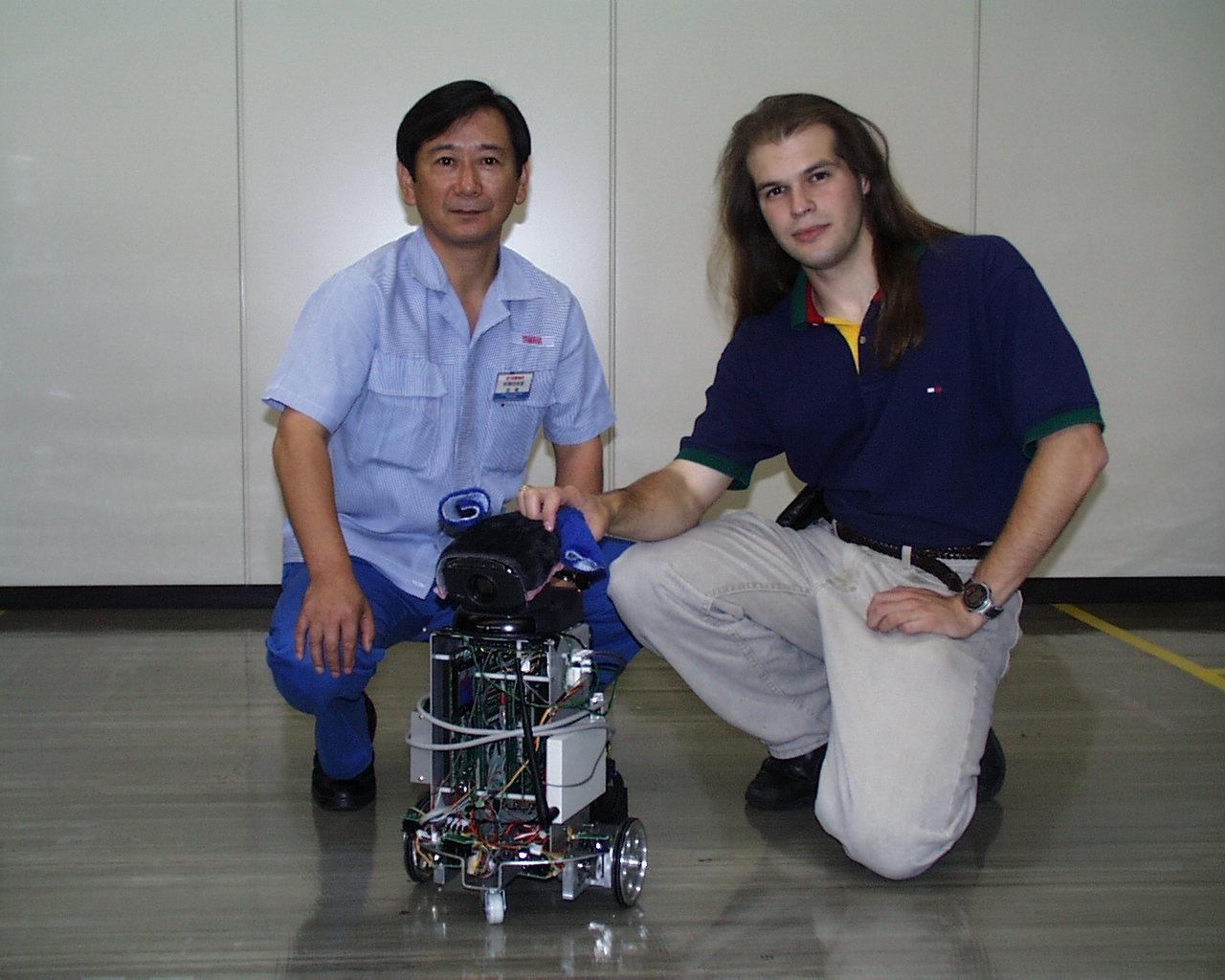
In a joint project with Georgia Tech and Yamaha Motor Corporation, I studied how emotional long term memory could improve the believability and ease the design of the construction of a robot pet. A publication on this is in press.Research Projects
I have published papers in the AAAI Workshop on Case-Based Reasoning, the Knowledge Compilation and Speedup Learning Workshop, and the European Conference on Machine Learning.- The Utility
Problem
The utility problem arises when knowledge learned to improve a problem solver's performance degrades it instead. I am investigating methodologies for the study of the utility problem and has applied those methodologies to case-based reasoning and control-rule learning systems.- Francis, A.G. and Ram, A. (1995). A Comparative Utility Analysis of Case-Based Reasoning and Control-Rule Problem Solving. In ECML-95: Proceedings of the Eighth European Conference on Machine Learning.
- Francis, A.G. and Ram, A. (1994). A Comparative Utility Analysis of Case-Based and Control-Rule Learning Systems. In AAAI-CBR-94: Workshop Notes on the AAAI-94 Workshop on Case-Based Reasoning..
- Francis, A.G., & Ram, A. (1993). Computational Models of the Utility Problem and their Application to an Analysis of Case-Based Reasoning. In KCSL-93: Proceedings of the Third International Workshop on Knowledge Compilation and Speedup Learning.
- Francis, A.G., & Ram, A. (1993). The Utility Problem in Case-Based Reasoning. Abstracted in AAAI-CBR-93, the Proceedings of the 1993 Case-Based Reasoning Workshop.
- Memory
in Humans and Computers
My research on memory investigates the advantages of spontaneous, asynchronous remindings and their effects on problem solving. I implemented a memory module, MOORE (the Memory Organization and Optimized Retrieval Engine), which is a testbed for these ideas. MOORE is designed to be a portable, generic memory system capable of use in many different kinds of AI systems.- Francis, A.G. & Ram, A. (in press). Can Your Architecture Do This: A Proposal for Impasse-driven Asychronous Memory Retrieval Request Generation. To appear in the AAAI-97 Fall Symposium on ROBOTS, SOFTBOTS, IMMOBOTS: Theories of Action, Planning and Control..
- Francis, A.G. (1994). Psychological Aspects of MOORE: The Memory Organization and Optimized Retrieval Engine. White paper.
- Agents
and Flexible Problem Solving
My research on agents and reasoning has led to the development of MPA, a multi-plan merging system for a least-commitment partial order planning system. MPA is a component of the larger Nicole Project, a flexible agent architecture which integrates reasoning components like MPA with a flexible meta-level controller and an opportunistic reminding system (MOORE).- Francis, A.G. & Ram, A. (in press). Can Your Architecture Do This: A Proposal for Impasse-driven Asychronous Memory Retrieval Request Generation. To appear in the AAAI-97 Fall Symposium on ROBOTS, SOFTBOTS, IMMOBOTS: Theories of Action, Planning and Control..
- Ram, A. & Francis, A.G. (1996). Multi-Plan Adaptation and Retrieval in an Experience-based Agent. In David Leake, Ed., Case-Based Reasoning: Experiences, Lessons, Future Directions.. MIT Press.
- Francis, A.G. & Ram, A. (1995). An Algorithm for Multi-Plan Adaptation and Merging for Least-Commitment Planners. In AKR-95: AAAI Fall Symposium on Adaptation of Knowledge for Reuse..
- Francis, A.G. (1995). Memory-Based Opportunistic Reasoning. Ph.D. Thesis Proposal. Also available in HTML format.
- Animal
Cognition
Along with Kurt Eiselt, I was involved in the 1994 Cognitive Science Conference Symposium on Animal Cognition. The Symposium will address issues in animal reasoning, animal communication, the possibility of animal language, and comparative animal-human studies. Speakers at the Symposium will also present recent work in the field of animal cognition. Featured speakers at the 1994 Symposium included Duane Rumbaugh, David Washburn, and Mike Tomasello.
Research Groups
While at Georgia Tech, I participated in several research groups, including the IGOR Group, the NLR Group, the Creativity Group, and, of course, the AI and Cognitive Science Groups.- The IGOR Group Research in learning, case-based reasoning, natural language understanding, creativity, education, and cognitive science.
- The NLR group An interdisciplinary research group investigating natural language issues.
- Artificial Intelligence Group The College of Computing's Artificial Intelligence program.
- Cognitive Science Group The interdisciplinary Cognitive Science program at Georgia Tech.
 By day, Anthony Francis
makes computers smarter; by night he writes science fiction and draws
comic books. He lives in San Jose with his wife and cats but his heart
will always belong in Atlanta.
By day, Anthony Francis
makes computers smarter; by night he writes science fiction and draws
comic books. He lives in San Jose with his wife and cats but his heart
will always belong in Atlanta.